30-Minute Magic: How We Extract a Brand Strategy from Brief Client Chats
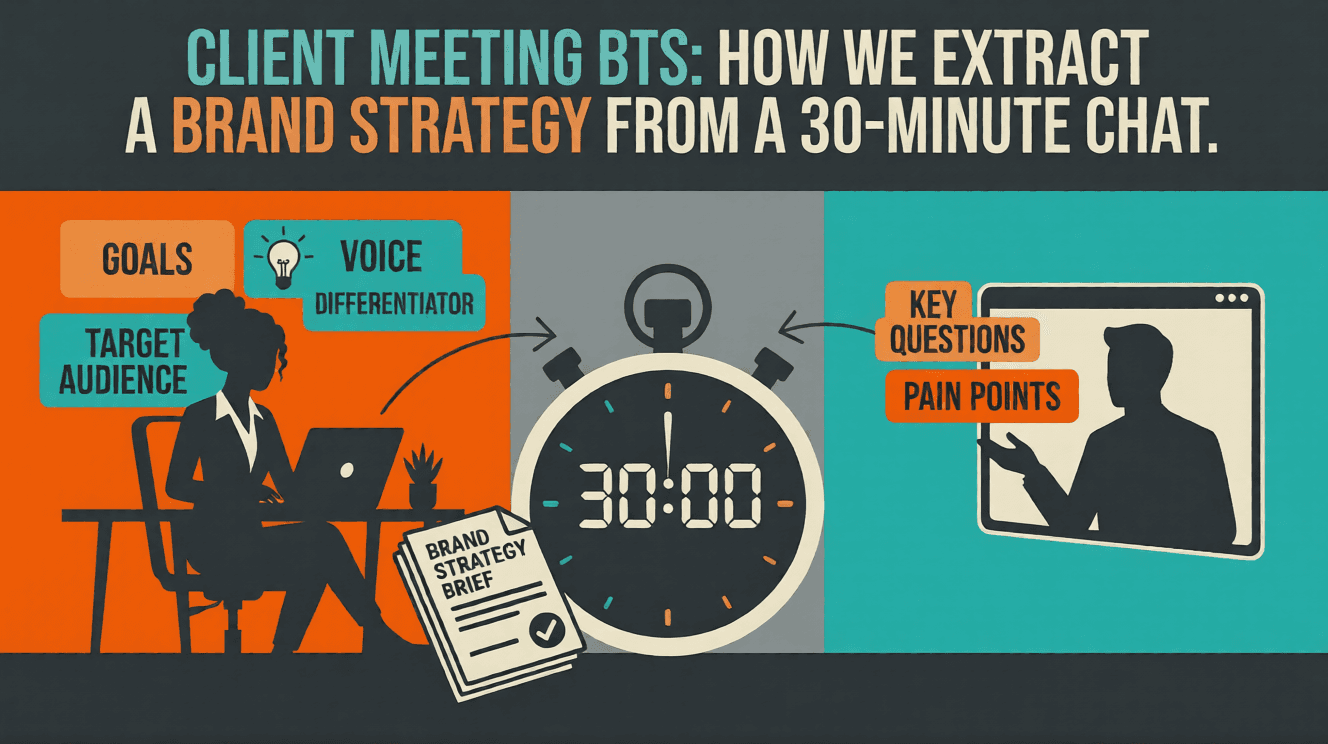
Client Meeting BTS: How We Extract a Brand Strategy from a 30-Minute Chat
Time is the most valuable commodity for both creative agencies and their clients. While multi-day workshops are fantastic, they aren't always feasible. Often, you only have a brief window to get to the heart of a client's business.
So, how do you extract a brand strategy when the clock is ticking?
In this behind-the-scenes look, we are pulling back the curtain on our exact agency process. We will show you how we turn a simple 30-minute discovery chat into a comprehensive, actionable brand foundation.
Quick Answer: How to Extract a Brand Strategy in 30 Minutes
To extract a brand strategy in 30 minutes, you must rely on heavy pre-meeting research, ask open-ended, targeted questions, and use active listening to identify core themes. Focus the conversation strictly on the brand's "Why," their target audience, and their key differentiators, leaving tactical design discussions for later.
The Challenge of the Short Discovery Call
A 30-minute meeting feels incredibly short when you are tasked with understanding the soul of a company. The biggest mistake strategists make is treating this time like a casual meet-and-greet.
If you let the client ramble about their favorite colors or minor operational details, the time will vanish. The goal is to steer the conversation with precision. You need to transition from small talk to deep, strategic insights within the first five minutes.
Step-by-Step: Extracting the Brand Strategy
Here is the exact formula we use to make every minute count.
Step 1: Pre-Meeting Research (The Unseen Work)
You cannot extract a brand strategy in 30 minutes if you start from zero. Before the client even logs onto the call, our team has already done the heavy lifting.
- Audited their digital presence: We review their current website, social media, and customer reviews.
- Competitor analysis: We identify 2-3 main competitors to understand the industry baseline.
- Pre-call questionnaire: We send a brief, 3-question intake form to get them thinking about their goals beforehand.
Step 2: The "Big Three" Questions
During the actual chat, we don't ask twenty questions; we ask three deeply layered ones. These are designed to bypass corporate jargon and get to the emotional core of the brand.
- "If your business disappeared tomorrow, what would your customers miss the most?" This reveals their true value proposition and emotional resonance.
- "Who is the one specific person you are trying to reach, and what keeps them up at night?" This forces them to define their target audience and the exact pain point they solve.
- "Why did you start this company, aside from making money?" This uncovers their brand purpose and origin story.
Step 3: Rapid Pattern Recognition
As the client answers, we aren't just transcribing; we are categorizing. We listen for repeating words, underlying frustrations, and passionate tone shifts. These recurring themes become the pillars of their brand positioning.
Essential Tools for a Quick Strategy Session
To maximize our efficiency, we rely on a specific tech stack during these brief calls.
| Tool Category | Purpose | Example Software |
|---|---|---|
| Meeting Recording | Allows us to focus on listening, not writing | Fathom, Otter.ai |
| Mind Mapping | For visual, rapid-fire note-taking during the call | Miro, FigJam |
| CRM/Notes | Centralizing client data and intake forms | Notion, HubSpot |
Translating the Chat into a Concrete Strategy
Once the 30 minutes are up, the real magic happens. We take the transcript and our mind maps and distill them into a one-page strategy brief.
This document outlines their Brand Purpose, Target Persona, Tone of Voice, and Competitive Advantage. Because we asked the right questions, the client reading the strategy document often says, "This is exactly what I meant, but I just didn't know how to say it."
Ultimately, extracting a brand strategy quickly isn't about rushing; it's about radical focus. By preparing thoroughly and asking the right questions, you can uncover the DNA of a brand in the time it takes to drink a cup of coffee.
External References
- HubSpot Blog: Tips for running effective client discovery calls and building rapport quickly.
- Forbes Agency Council: Articles on the importance of agile brand strategy for modern businesses.
- Harvard Business Review: Research on active listening and effective executive communication.
Frequently Asked Questions
Can you really build a comprehensive brand strategy in 30 minutes?
You cannot build a massive, 50-page corporate strategy in 30 minutes. However, you can extract the core foundational elements—purpose, audience, and differentiator—which provides enough direction to begin the creative process or draft a preliminary strategic brief.
What if the client doesn't know the answers to the questions?
If a client struggles to answer the "Big Three" questions, that is valuable data in itself. It indicates they lack brand clarity. In these cases, the 30-minute chat serves to highlight this gap, allowing us to pivot and recommend a deeper, paid strategy workshop.
Should I charge for a 30-minute discovery call?
Typically, a 30-minute initial discovery call is offered for free as a sales and qualification tool. The goal is to extract enough strategic insight to write a winning proposal. The comprehensive strategy development that follows the call is what you charge for.
What happens immediately after the 30-minute meeting?
Immediately after the meeting, we review the automated transcript, highlight key emotional phrases, and synthesize the data into a preliminary strategy brief or proposal. This is usually sent back to the client within 24 to 48 hours to maintain momentum.
Work with Art Drawn Studio